
Southampton Tea Truffle
Bespoke Chocolates, $2.25
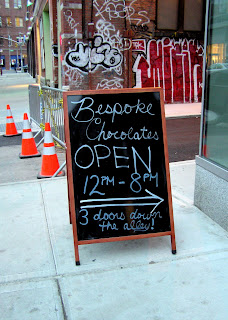
Extra Place doesn't exactly welcome visitors, particularly in the gathering dusk of a late winter evening. It's a stunted alleyway just off the Bowery, too small to appear on most maps, wallpapered with graffiti, and, on the occasion of my visit, bedecked with police tape. That it's not the kind of place where you'd expect to find an artisanal chocolate shop makes stepping out of the alley and into Bespoke Chocolates that much more delightful.
Open less than a year, Bespoke has made its name with impeccably crafted small-batch chocolates featuring creative flavor profiles. At the helm is London-trained chocolatier Rachel Zoe Insler, whose previous career was in "academic cognitive neuroscience research".

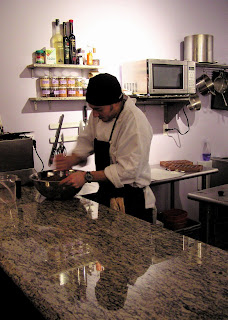
While I don't want to belabor that transition or cast Insler as a cocoa-streaked mad scientist, it's hard not to look at the shop and see echoes of a laboratory or an old-fashioned apothecary as apron-clad chocolatiers bustle around in plain sight behind the gleaming marble counter of an open kitchen. As they patiently answer questions about their creations, it also becomes apparent that their process is suspiciously scientific.
I asked about the genesis of my chosen truffle, the Southampton Tea (top photo), and heard a tale of drawn-out research and methodical experimentation; infusing the silky-smooth ganache with a maximum wallop of apricot-scented Ceylon tea was not as straightforward as you might think. While the shell of fruity Caribbean chocolate comes from readymade couverture, it was given perhaps the most perfect temper I've ever experienced; snapping my front teeth through the shell seemed to set off tiny shockwaves, and a millisecond later the glossy chocolate cracked into two halves held loosely together by oozing ganache.
Bespoke is also famous for an award-winning confection filled with liquid, sea-salted caramel and rolled in crumbled pretzels (below right, front), and a hand-beaten spread of chocolate, hazelnuts, and Marcona almonds (in process, below left).

Bespoke Chocolates
6 Extra Place
New York NY, 10003
212/260-7103

 Les Tres Leches Doughnut
The Doughnut Plant, $2.25
Les Tres Leches Doughnut
The Doughnut Plant, $2.25
While the Doughnut Plant's website is full of streamlined graphics and elegant animation, by far the most moving feature is a slideshow of owner Mark Isreal's family photos, ending with a heartfelt thanks to his supportive loved ones. Several black-and-white snapshots feature his grandfather, a commercial baker who died with Isreal was only a toddler but left behind a valuable legacy scrawled on a yellowing index card: the recipe for an egg-free yeast doughnut.
Those light, fluffy, and vegetarian-friendly doughnuts were the foundation of the grandson's fortunes. For five years, working in a converted tenement basement, Isreal baked through the night, then delivered doughnuts to high-end retail outlets by bike each morning. In his spare time, Isreal perfected an original recipe for a stellar cake doughnut, now available in flavors such as Blackout (chocolate encrusted chocolate cake bursting with chocolate pudding) and the Cinco de Mayo-inspired Les Tres Leches (pictured above). The Factory's square jelly doughnuts are also a departure from the norm; instead of a single jelly core waiting to drop in your lap like hot lava, there's a generous seam of house-made fruit preserves circling the dough like an enclosed racetrack.
Doughnut Plant products contain no transfats, no preservatives, and no artificial flavors. They are made with carefully chosen ingredients--Valhrona chocolate, Tahitian vanilla, fresh coconut, seasonal fruit, and nuts that are roasted and ground on the premises. Ingredients like lavender buds, Meyer lemons, or rose petals that could end up as just so much frippery are used deliberately and to full, flavorful effect. Overseas shops (in Tokyo and Korea) have a slightly different menu, featuring local produce and flavors (shiso and yuzu!).
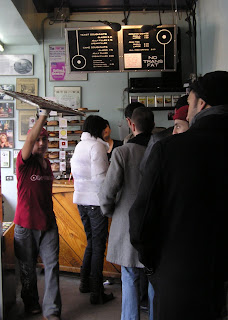
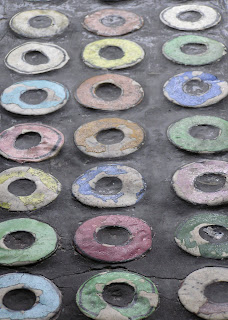
After waiting in a long but snappy line at the Plant's Lower East Side store, I ordered a cup of hot, strong chai and a Tres Leches and perched on the windowseat to eat. The seat was delightful--crayon-colored tiles stamped out with a doughnut cutter and raku-fired by Isreal's father, Marvin. The doughnut was even better--plump and light, with a milky glaze and a mildly sweet, sensuously creamy filling. The "three milks" were in harmonious balance, no one flavor or texture overpowering the others. As I ate I found myself thinking of St. Exupery's definition of perfection--"...not when nothing more can be added, but when nothing more can be taken away.”

Karume
Daiso Japan, $1.50
Thanks to Daiso, the Japanese "dollar" store, you can try a treat that would have been familiar to children living in Japanese cities more than 100 years ago.
Karume are feather-light hard brown lumps with hexagonal sides and ravaged-looking tops. Pop one in your mouth for a rather straightforward brown sugar flavor and a comparatively intricate textural experience: the porous sweet slowly erodes from the inside out and collapses in on itself in a jumble of shards and syrup.
Karume are a kind of dagashi, a category of "cheap sweets" that became popular among urban children during Japan's Meiji period, when increased foreign trade made sugar affordable for the masses.
According to Eric Rath in Food and Fantasy in Early Modern Japan, the historic precursor to our modern factory-formed karume was called karumeyaki, and it was then as much as taste of the future as karume is now a taste of the past. Although the -yaki suffix is more usually attached to something that has been cooked or grilled, these candies get their bubbled appearance and hard shell from a chemical reaction caused by the addition of baking soda--an ingredient first introduced to Japan in the Meiji period.
This reaction is so spectacular that a university handout I found characterizes karume-making as a science experiment rather than a recipe. In essence, you beat egg whites to a soft froth, stir in baking soda, then combine the egg with melted brown sugar. The mixture foams furiously, and the bubbles can be hardened by cooking over a gentle flame.
Burro Bananas
Although half of the global banana crop and most of the bananas consumed in the US are of the iconic Cavendish variety, there are hundreds of other bananas out there--not all of them mild-flavored, yellow, or shaped like a telephone receiver. Compared to it's more ubiquitous cousin, the Central American "burro" banana is adorably stubby, like a well-used pencil, with a flavor that leans towards tartness and a firmer, almost crunchy texture.
Kue Wajik
A favorite street snack in both Indonesia (kue wajik) and Malaysia (kuih wajik), this simple rice cake showcases the quality of its three main ingredients: sticky rice, coconut milk, and palm sugar. Made from the sweet sap of various types of palm tree, the color, flavor, and texture of palm sugars can vary enormously according to the trace minerals that remain after processing. Search for images of kue wajik and you'll see cakes that look golden, tan, rusty, or as if they've been doused in barbecue sauce, thanks to minimally refined palm sugars like gula melaka or gula jawa. Made with the paler, more processed palm sugar from a Seattle grocery, my kue a little anemic-looking--but still delicious.

Jeni's Splendid Ice Creams
3-scoop cup, $5.50
On at least a hundred occasions I've filled a Baskin-Robbins' cup with one of the clashing-est combinations possible: one scoop of peanut-butter-chocolate AND one of daquiri ice. And never has a B-R server paused and gently suggested to me that perhaps the flavors I'd requested might not pair very well together. I had to go to Jeni's Splendid Ice Creams for that.
I first had Jeni's several years ago at the original location in the Columbus, Ohio covered market and quickly decided that a second serving would justify a return trip to Ohio. Since then the business has boomed and you can now find Jeni's outlets sprinkled around the Southeast.
The lines are long and slow, but even so the servers patiently encourage careful decision making and thorough sampling. Before coming in I'd read the profiles of all of the current flavors online and made a plan, but I still sampled almost everything--you know, just to be sure.
My first choice was Yazoo Sue with rosemary bar nuts: "Built from the ground up with a creamy, rich, and mellow cherry wood-smoked porter (by Nashville's Yazoo Brewing Company) and fistfuls of savory 'bar nuts'—peanuts, pecans, and almonds dusted with rosemary, brown sugar, and cayenne." Second, Black Coffee: "We steep Batdorf & Bronson's single-estate coffee right in the cream (rather than in water). Our process yields coffee ice cream that tastes as delicious as a cup of intensely flavorful coffee smells."
Last, I shoehorned in the flavor that my concerned server suggested might not play well with the others, Cherry Lambic Sorbet: "If your memory says, 'Skip it because it’s gonna taste like artificial, super-sweet cherry flavoring,' don’t trust your memory. In fact, our Cherry Lambic sorbet won the Gallo Family Vineyards award in 2008. We used the money we won from this award to begin direct-sourcing vanilla beans and pure vanilla extract from Ndali Estate in Uganda."
When I wouldn't budge, we came up with a compromise: my server used waffle cookies to craft a dam between the creamy flavors and the tart one.
Jeni's Splendid Ice Creams
1892 Eastland Avenue
Nashville TN
615/262-8611
Coffee Soda
Crema Coffee
I've always loved the idea of coffee-flavored soda but had yet to drink one that matched up with the nectar of my imagination. Then came Crema. Their coffee soda blows my expectations out of the water, in large part because it's not coffee-flavored, but actual coffee that they carbonate to order. A rotating selection of cold-brews get poured into some kind of Rube Goldberg carbonating contraption that requires a (trainee?) barista to shake it vigorously for several minutes. To that they add ice, mellow demerara simple syrup, and a zippy little twist of orange zest. Bring on the 100% humidity!
Crema Coffee
15 Hermitage Ave
Nashville, TN
615/255-8311


