Seafoam
Boehm's Chocolates
Isn't science wonderful? The same volcanic combination of vinegar and baking soda that I rely on to de-gunk my drains gives seafoam candy its distinctive honeycomb texture. Molasses adds a rich depth to the flavor and a dark chocolate coating seals in the foamy freshness so each bite is crisp and crunchy.
Boehm's Chocolates
255 NE Gilman Blvd, Issaquah, WA 98027
425 / 392-6652
 Colt's Bolts
Nashville Airport, $1.99
Colt's Bolts
Nashville Airport, $1.99
On the one hand, a Colt's Bolt is a dressed-up Reese's Peanut Butter Cup; on the other, it's a country song wrapped in foil.
On the label of each confection is a 1980's glamor shot of blonde in a red power suit, company owner Mackenzie Colt. A teenage wife and mother with talent and ambition, Colt was a regular at open mic nights at the Ramada Inn lounge near her St. Louis home, where she was discovered by Buck Owens. After touring as Owens' protege, she moved to Nashville for a six-season stint as a scantily-clad "Hee Haw Honey."
When she aged out of her Hee Haw role, Colt had a Plan C waiting in the wings: a lifelong passion for baking and confectionery. In 1984 she began to combine chocolate, peanut butter, and roasted almonds into candy cups she called Colt's Bolts. At first she mixed all of the ingredients in her own Cuisinart and wrapped the finished cups in the foil left over from chocolate bars she melted down for her coating. All that had to change after Colt's Bolts won the Fancy Food Show's Outstanding Confection Award and a Japanese distributor ordered 60,000 pieces.
Russian Mini Chocolate Bars
Mom's European Food & Deli, $6.99/lb
Soap Lake is a tiny town in central Washington built around a lake long famed for the healing properties of its foamy waters and slimy mud. Modern environmental factors have put a dent in those powers--and in the number of tourists visiting the town's spas and resorts. From the car I saw two going-out-of-business sales, several vacant storefronts, and the empty lot where town boosters had once planned to erect the world's largest lava lamp.
There was no one else in sight when I parked by the public swimming area just a block from downtown, rolled up my pants, and waded into the shallow, slightly effervescent water. There was no one in sight as I stood ankle-deep in mud, creamy and insubstantial as Cool Whip, and wondered what it would be like to live here.
I was starting to get a little spooked when a stroll down main street finally filled in a few of the blanks. As I passed a strikingly well-stocked yarn store, there was a flurry of activity; car after car pulled up and a dozen chatty women got out carrying snacks and projects for the weekly "stitch and bitch."
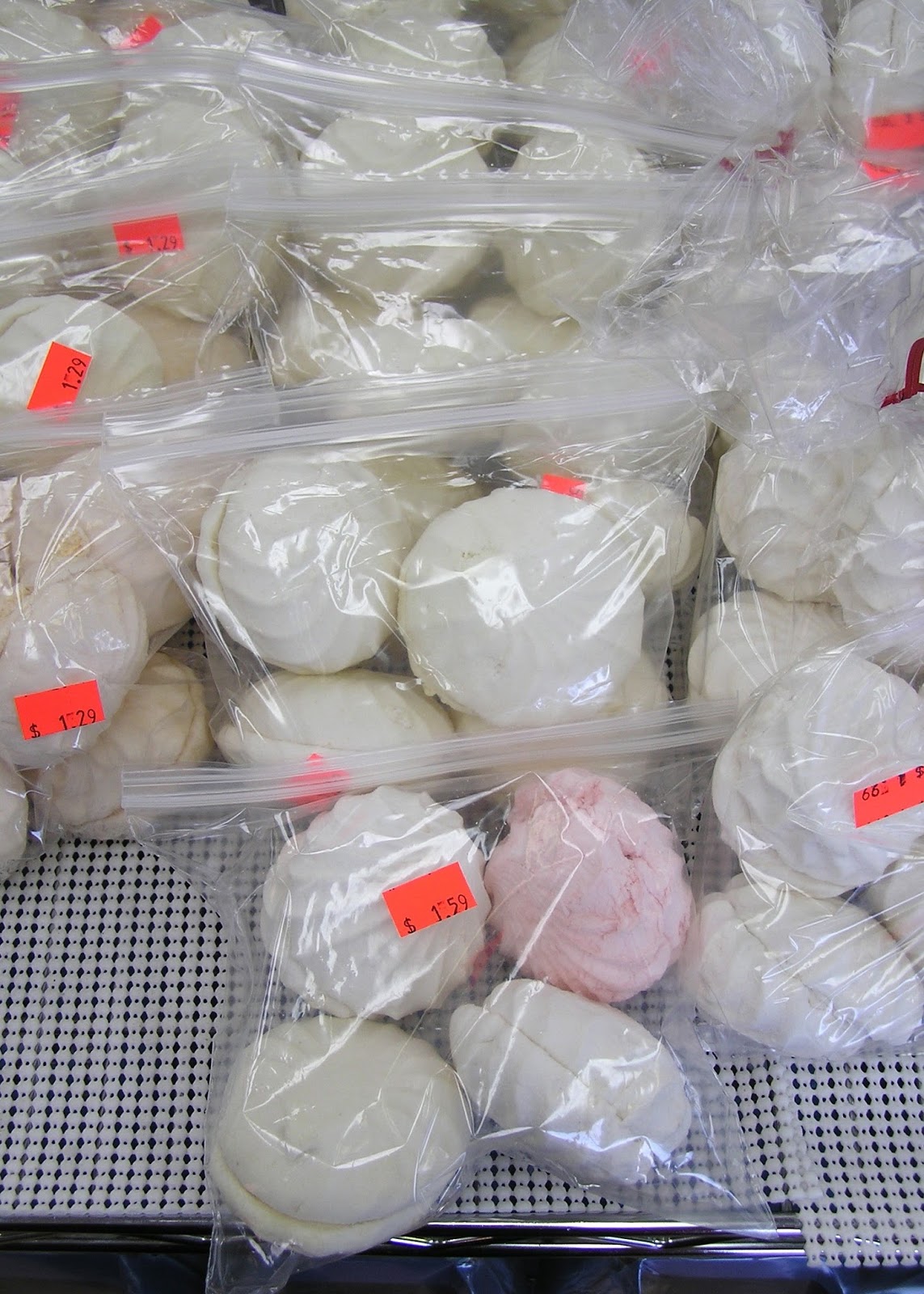
At the other end of the street, I found Mom's European Deli, a strikingly well-stocked emporium of foods from Russia and the Baltic region--deli staples like meat, cheese, and specialty breads, but also row upon row of sweet snacks. The dozens of individually wrapped hard candies, caramels, and nutty little dark chocolate bars (like Clumsy Bear, Nut Cluster, Kara Kym, above) are sold pick-and-mix style by the pound, as is sesame and sunflower halva, cut to order from huge marbled blocks. There are also sweet drinks, boxed cookies, and bags of confections like zephir, a pastel hybrid of marshmallow and divinity. The cold case is stocked with fresh cakes from Russian bakeries on the east coast, carried back by long-haul truck drivers returning from a New York run.
The beach may no longer be bustling, but an unexpected bounty of beautiful yarn and Russian treats prove that there's still life, creativity, community, and celebration behind Soap Lake's hard-luck facade.
Mom's European Food & Deli
331 Main Ave E
Soap Lake WA
509/246-1121
Karume
Daiso Japan, $1.50
Thanks to Daiso, the Japanese "dollar" store, you can try a treat that would have been familiar to children living in Japanese cities more than 100 years ago.
Karume are feather-light hard brown lumps with hexagonal sides and ravaged-looking tops. Pop one in your mouth for a rather straightforward brown sugar flavor and a comparatively intricate textural experience: the porous sweet slowly erodes from the inside out and collapses in on itself in a jumble of shards and syrup.
Karume are a kind of dagashi, a category of "cheap sweets" that became popular among urban children during Japan's Meiji period, when increased foreign trade made sugar affordable for the masses.
According to Eric Rath in Food and Fantasy in Early Modern Japan, the historic precursor to our modern factory-formed karume was called karumeyaki, and it was then as much as taste of the future as karume is now a taste of the past. Although the -yaki suffix is more usually attached to something that has been cooked or grilled, these candies get their bubbled appearance and hard shell from a chemical reaction caused by the addition of baking soda--an ingredient first introduced to Japan in the Meiji period.
This reaction is so spectacular that a university handout I found characterizes karume-making as a science experiment rather than a recipe. In essence, you beat egg whites to a soft froth, stir in baking soda, then combine the egg with melted brown sugar. The mixture foams furiously, and the bubbles can be hardened by cooking over a gentle flame.